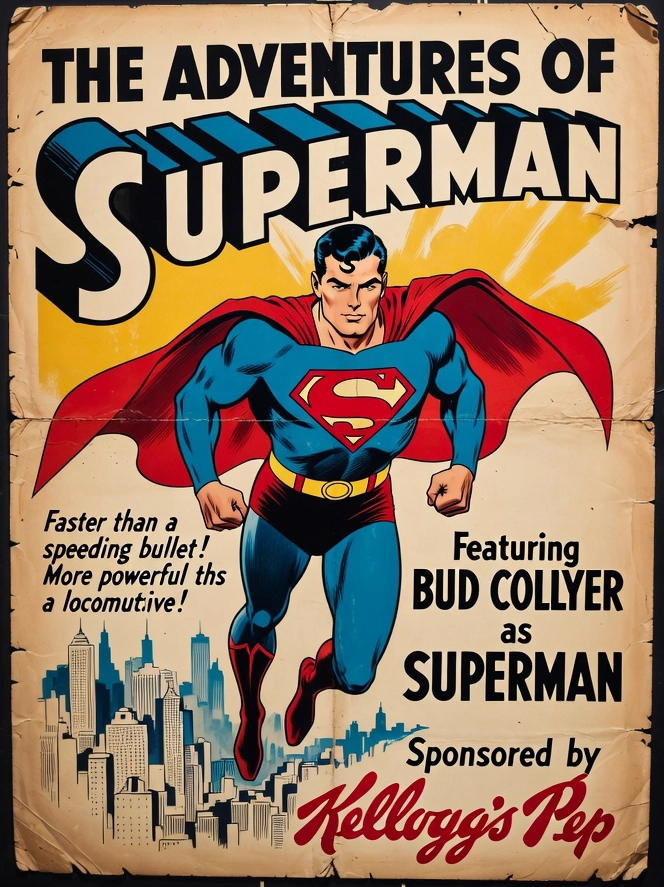
The Adventures of Superman
How the Man of Steel Found His Radio Voice
Before there was a Superman film serial, before there were Fleischer animated shorts, before flight was even an established part of Superman's powers in the comic books, there was a radio program — and in several ways, the radio program got there first. The Adventures of Superman debuted on February 12, 1940, launching in transcribed syndication on WOR in New York and spreading within weeks to stations in Connecticut, Pennsylvania, and Los Angeles. Within ten weeks of its debut, it had earned a Crossley rating of 5.6 — the highest of any thrice-weekly program on the air at that moment. By May 1941, the show had grown from its original 11 stations to 63; when the syndicated run ended in February 1942, it was playing in 85 North American markets. The character's leap into popular culture was already underway: on July 3, 1940, a "Superman Day" was promoted at the New York World's Fair, with early WOR advertisements distributed by Macy's.
The show was the brainchild of Allen "Duke" Ducovny, a DC Comics press agent, and Robert Joffe Maxwell, a former pulp fiction writer whom DC owner Harry Donenfeld had hired to oversee subsidiary licensing rights through a company called Superman Inc. Maxwell and Ducovny co-wrote the famous network opening together, and they later described the process cheerfully: "We had a lot of fun writing that opening. It was a typical radio action piece that fully utilized sound effects." Four audition episodes were prepared in late 1939 to sell the show to prospective sponsors. The first of those sponsors was the Hecker H-O (Hornby's Oatmeal) Company of Buffalo, New York; the wider syndicated run was supported by a patchwork of regional grocery and food advertisers including Force Wheat Flakes, Proctor & Gamble, Skippy Peanut Butter, and Stroehmann's Bread, with the Ogilvie Flour Mills Company carrying the show in Canada.
The premiere episode, "The Baby from Krypton," aired on February 12, 1940. It told the story of the destruction of the planet Krypton and the scientist Jor-El and his wife Lara sending their infant son to Earth in a rocket. In those early episodes, Krypton was placed on the far side of Earth's sun, and the baby actually grew into an adult during the journey — a backstory later revised to match the comic-book version. Ned Wever and Agnes Moorehead played the infant's parents in the premiere, with a cast drawn from New York radio actors that also included Santos Ortega and, in an early appearance, Frank Lovejoy. George Lowther, brought onto the staff in October 1940 after his work on Dick Tracy and The Shadow, would prove instrumental in shaping the early production. Lowther directed, scripted prolifically, and in 1942 authored the first novelization of any comic book character — The Adventures of Superman, published by Random House on November 2 of that year, with illustrations by Superman co-creator Joe Shuster. That novel introduced the names Jor-El and Lara and named Clark Kent's adoptive parents Eben and Sarah Kent, details the broader Superman mythology quietly absorbed. Lowther (1913–1975) later joined DuMont Television as executive producer in 1945 and wrote more than thirty scripts for CBS Radio Mystery Theater before his death. He was part of a larger creative bench: Robert Maxwell, Jessica Maxwell, Mitchell Grayson, and Allen Ducovny shared directing duties at various points, Jack Johnstone and B. P. Freeman handled major writing assignments, and the show's signature audio texture came from a sound-effects team of Jack Keane, Al Binnie, Keene Crockett, and John Glennon.
The Opening That Defined an Era
Mutual picked up the series on August 31, 1942, partly as a tactical move to offset losing its top juvenile program, Jack Armstrong, the All-American Boy, to NBC's Blue Network. The network run settled into a 15-minute format airing initially three times a week, then mostly five times a week, with Kellogg's Pep as the sponsor from January 1943 through December 1947. It was on Mutual that the show's signature opening reached the form most listeners remember.
That opening was, by any measure, one of the most carefully constructed sequences in radio. A cascade of voices, narration, and sound effects tumbled together: "Faster than a speeding bullet! More powerful than a locomotive! Able to leap tall buildings at a single bound!" — followed by the famous triple-take: "Look! Up in the sky! It's a bird! It's a plane! It's SUPERMAN!" That version replaced an earlier opening — "Presenting the transcription feature, Superman!" — which had been the most-heard radio opening through the mid-1940s. The more familiar version was in place by approximately September 5, 1945. The sound effect representing Superman's flight was itself an engineering accomplishment: a mix of a Spanish War bomb dropping, a recording of a 50-mile gale, and a wind machine blended into a rushing, impossible roar.
Superman's premise was stated in the same efficient, repeated strokes each episode. Clark Kent was described as "a mild-mannered reporter for a great metropolitan newspaper" engaged in "a never-ending battle for truth, justice, and the American way." His glasses and meek demeanor kept his secret. His editor, Perry White, bullied him. His colleague Lois Lane barely tolerated him. The same Lois Lane adored Superman with complete uncritical enthusiasm, never connecting the two. The irony was built into the structure of every episode and never wore out.
The Actor Behind the Voice
The roles of Clark Kent and Superman were originally written for two different actors, and the problem of having one man play both was solved by Clayton "Bud" Collyer's technique of dropping from a mild-mannered tenor to a deep baritone — a shift he could pull off in the time it took to say "This looks like a job for… SUPERMAN!" That mid-sentence transformation became one of radio's most recognizable performance signatures.
Collyer, born Clayton Johnson Heermance Jr. on June 18, 1908, had attended Williams College and Fordham University Law School before discovering that one month of radio work paid more than an entire year of legal clerking. His pre-Superman credits included Pat Ryan on Terry and the Pirates, the title role in Renfrew of the Mounted, the title role in Abie's Irish Rose, and announcing duties on The Guiding Light and The Goldbergs. He later recalled his ambivalence about taking the Superman role, fearing it would damage his reputation as a serious actor — though he came to see it differently: "The greatest fun I ever had in radio was playing Superman for 14 years. I could be as hammy as I wanted and nobody objected."
The producers, meanwhile, insisted on extraordinary measures to protect the fictional illusion. Anyone in the storyline who discovered Superman's true identity had to be eliminated — killed off by accident or some convenient disaster. And Collyer's own identity was kept secret from the public. Only in 1946 did he emerge publicly, in an interview with Time magazine, connected to the show's campaign against racial and religious intolerance. He went on to host the television game shows Beat the Clock (1950–1961) and To Tell the Truth (1956–1968), and his catchphrase from that latter program — "Will the real [name] please stand up?" — entered common usage. Collyer died on September 8, 1969, and was posthumously named among DC Comics' "Fifty Who Made DC Great."
Joan Alexander played Lois Lane for most of the run, though she was not the first. Rolly Bester originated the role for the show's first two weeks (February 26 through March 8, 1940), and Helen Choate followed before Alexander settled into the part for the long haul. Alexander's performance carried into the Fleischer and Famous Studios animated shorts from 1941 to 1943, as well as a 1966 revival, and she later expressed some frustration at being remembered primarily for the Lois Lane role rather than for stage work in Shakespeare or Shaw. Jackson Beck, who became the show's narrator from around 1943, also voiced Beany Martin, the Daily Planet's copy boy, and on Batman guest episodes played Bruce Wayne's butler Alfred Pennyworth. Beck's first appearance on the series had been February 18, 1942, playing a South American gaucho in the "Ghost Car" storyline. The name Perry White, now inseparable from Superman, was created for the radio series; so was the character of Jimmy Olsen, a freckle-faced cub reporter whose function, explicitly conceived, was to give Superman someone to explain plot developments to. Police Inspector Bill Henderson, a recurring character voiced first by Matt Crowley and later by Earl George, was also a radio original — and like White and Olsen, was eventually adopted into the comic books.
The Daily Planet itself went through a brief identity crisis: in the very first audition pilot, Clark Kent worked for a paper called the Daily Flash, then briefly the Daily Star, before the name Daily Planet was established.
The 'Clan of the Fiery Cross' and the Fight Against Intolerance
The most discussed story arc of the entire run aired in a concentrated burst of 16 episodes from June 10 to June 25, 1946. "The Clan of the Fiery Cross" was part of a group of post-war stories the production team called the "Unity House" stories, all dealing with racial and religious intolerance — and the series was the first of its genre to tackle those subjects directly.
In "Clan of the Fiery Cross," a Chinese-American family named the Lees moves into the Metropolis suburbs and is targeted by a thinly-veiled Klan organization whose leader is called the Grand Scorpion. The story ran with Kellogg's Pep's support, and sponsor intimidation was reportedly attempted: KKK Grand Dragon Samuel Green ordered new passwords issued after hearing what he believed were actual Klan codes broadcast on the show, and launched a boycott of Kellogg's. The company refused to back down, and the arc earned what were described as spectacular ratings. The audience numbers from this stretch of the run bear that out: in January 1945 the show was reaching 3.1% of American radios, and by January 1946 — just months before the Clan arc aired — that figure had risen to 4.4%, a notable lift that tracked with the Unity House stories. Superman historian Michael Hayde, author of Flights of Fantasy: The Unauthorized but True Story of Radio & TV's Adventures of Superman (BearManor Media, 2009), has raised some caution about the most dramatic claim here — he found only one sequence in the broadcast that might plausibly be construed as proprietary to the Klan — but the broader cultural impact of the arc was substantial regardless. Stephen J. Dubner and Steven Levitt, in Freakonomics (2005), credited "Clan of the Fiery Cross" as "the greatest single contributor to the weakening of the Ku Klux Klan." The story was adapted decades later into the DC Comics limited series Superman Smashes the Klan, written by Gene Luen Yang with art by Gurihiru, released in October 2019.
The intolerance campaign had a biographical footnote: Collyer's 1946 emergence into public view — the first time the public knew who voiced Superman — was timed directly to his role in publicizing the show's anti-bigotry message. His cooperation with Time magazine broke the producers' long-standing policy of keeping the actor's identity secret.
Kryptonite, Batman, and the Shape of the Mythology
Several elements now considered fundamental to the Superman mythology were either invented for the radio series or received their first coherent treatment there. Kryptonite appeared on the show in "The Meteor from Krypton," a seven-part storyline that first broadcast June 3–11, 1943, written and directed by George Lowther. The fragment glowed "like a green diamond" and weakened Superman within 5 to 10 feet — a precise, practical limitation that gave the show's writers a tool for putting Superman in genuine jeopardy.
The most sustained use of that tool came with Atom Man, a Nazi super-soldier given kryptonite-powered abilities, who arrived in a 19-part arc broadcast October through November 1945. The character returned almost immediately in "Atom Man in Metropolis" (November–December 1945, another 19 parts), and the larger kryptonite-focused sequence around these arcs has been described by some sources as spanning 76 connected episodes — making Atom Man the most extended single antagonist of the entire run, and a direct fusion of the two threats the show had been working with all along: a vulnerable Superman and an enemy shaped by the war.
The radio series was also the first medium in which Superman flew. The ability was introduced in the 1939 audition episode "The Origin of Superman, Part 2," predating the first Fleischer animated short by nearly two years, and predating the official comics debut of flight in Action Comics #65 (October 1943) by several years. On radio, the flight was conveyed through that hybrid sound effect of bomb, gale recording, and wind machine, accompanied by the shout "Up, up, and away!" — three words that needed no visual support whatsoever.
Batman made his first joint appearance with Superman on September 10, 1945 — the first time the two characters had worked together as a team in any medium. Batman and Robin guest-starred across 13 radio serials over several years. Gary Merrill, Stacy Harris, and Matt Crowley each took turns playing Batman at different points; Ronald Liss played Robin. The crossover was a genuine novelty, but Batman suffered in comparison to his host: he couldn't fly, couldn't see through walls, couldn't stop bullets, and the story limitations that followed were hard to work around. Batman's presence on the show faded, and a standalone Batman radio program never materialized.
The End of the Run and What Survived
The Mutual network run ended on June 24, 1949, with the episode "The Mystery of the Frozen Monster." A brief 30-minute Mutual revival ran from January 31 to June 17, 1949, airing three times a week. The show then moved to ABC, running from November 5, 1949 to March 1, 1951, initially in a Saturday-evening slot at 8:30 that later shifted to 8:00, and eventually airing twice weekly at 5:30 from June 1950.
The ABC run brought casting changes. Michael Fitzmaurice replaced Bud Collyer in 1950; Jack Grimes replaced Jackie Kelk as Jimmy Olsen; Ross Martin replaced Jackson Beck as narrator. Collyer's final performance as Clark Kent/Superman came on January 21, 1950, with the episode "Dead Men Tell No Tales." The series itself ended on March 1, 1951, with "The Mystery of the Prehistoric Monster."
Because the show never repeated episodes, it produced 2,088 original episodes over its run — a figure that reflects both the relentless pace of daily serial production and the show's durability across more than a decade. The Mutual Network episodes from August 31, 1942 through September 3, 1945 are either wholly or partially missing from surviving collections, a gap that affects some of the show's most significant story arcs. Notable surviving arcs include "Looking for Kryptonite" (26 parts, December 1945–January 1946), "The Hate Mongers' Organization" (25 episodes), and "Superman vs. Kryptonite" (33 episodes).
The show's reach extended beyond North America. An Australian version ran from 1949 to 1954 on Sydney radio station 2GB, airing Monday through Thursday at 6:30 p.m. It starred Brisbane native Leonard Teale as Superman and Margaret Christensen as Lois Lane, used new scripts rather than translations of the American originals, and featured a distinct origin story in which Superman arrives on Earth as an adult and his Clark Kent persona is conceived by two people he rescues. That Australian run produced at least 1,040 fifteen-minute episodes; the National Film and Sound Archive of Australia holds an incomplete collection ranging from episode 1 through episode 1,020. Teale later became well known to Australian television audiences through the long-running series Homicide (1964–1977). The Australian version's main theme was the Rienzi Overture by Richard Wagner.
The Columbia movie serials of 1948 and 1950 were adapted from the Mutual Network radio program rather than from original comic-book stories. The Paramount/Fleischer animated shorts of 1941–1943, Academy Award-nominated, used the same voice cast as the radio series. Collyer reprised the role in the 1960s for record albums and three animated television series. The voices of The Adventures of Superman proved more durable than the medium itself.